

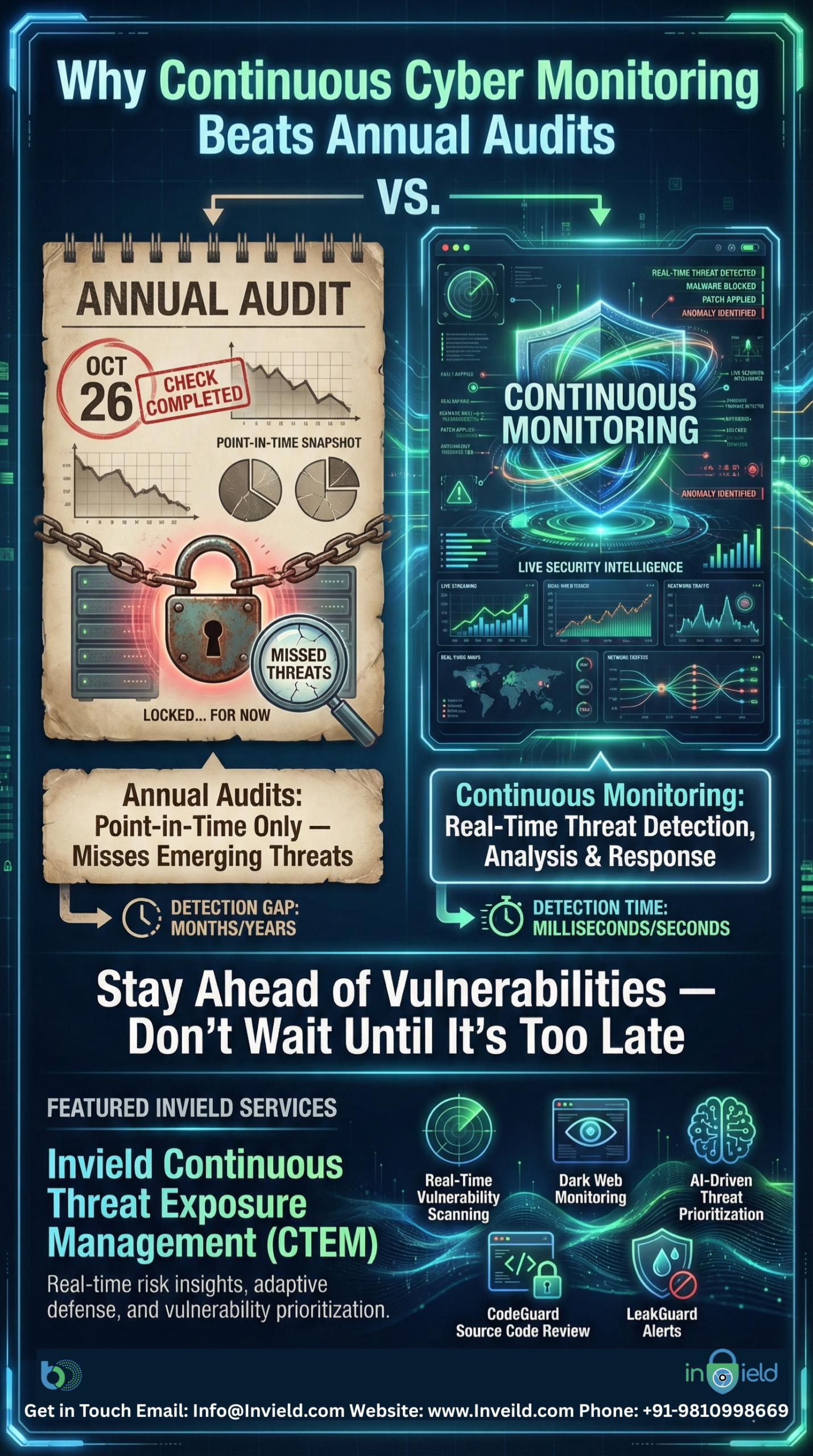
In the rapidly evolving digital landscape, cyber threats no longer unfold over months or years they emerge and escalate in minutes and hours. Yet, despite this dynamism, many organizations still rely heavily on annual cybersecurity audits: scheduled, labour-intensive reviews that provide a snapshot of security posture at a single point in time. While useful, these periodic assessments are fundamentally mismatched with the realities of modern threat environments.
This is where Continuous Cyber Monitoring (CCM) — especially advanced frameworks like Continuous Threat Exposure Management (CTEM) offered by Invield — delivers decisive advantages. Rather than looking backward, continuous monitoring keeps organizations aware, resilient, and secure every minute of every day.
cybersecurity audit is a structured evaluation of an organization’s digital defenses, controls, policies, and risks. Its purpose is to uncover vulnerabilities, ensure compliance with standards, and strengthen security practices. Audits typically involve documentation, analysis, testing of controls, and compliance checks against frameworks such as ISO 27001 or PCI DSS.
While audits serve important functions — especially for compliance and governance — they only provide a point-in-time examination of an organization’s cybersecurity posture. The gap between audit cycles — often quarterly or annual — means:
- Threats can emerge and persist undetected long before the next audit.
- Control weaknesses can be exploited continuously, with attackers moving laterally across systems.
- Audit findings quickly become outdated, often within weeks of completion.
- Compliance readiness degrades over time, increasing regulatory and contractual risk.
Continuous Cyber Monitoring is a real-time, automated approach to cybersecurity. Instead of occasional reviews, it constantly observes and analyzes network activity, systems, configurations, user behavior, and threat signals. The result is dynamic visibility into risk and compliance posture.
- SIEM (Security Information and Event Management)
- XDR (Extended Detection and Response)
- Real-time vulnerability scanning
- Behavioural and anomaly detection
- Automated compliance tracking
Rather than waiting for scheduled events, security teams are alerted immediately when threats or deviations occur — enabling faster detection, response, and remediation. This shift — from reactive to proactive defense — is where continuous monitoring outperforms periodic audits.
Continuous Monitoring vs. Annual Audits
1. Real-Time Threat Detection and Response: Traditional audits examine past records — historical logs and configurations gathered over days or months. By contrast, continuous monitoring sees current, live data streams.
- Threats are detected as they occur.
- Suspicious behavior can trigger automatic alerts and containment actions.
- Breaches are identified before they escalate into major incidents.
For example, a malicious insider attempting unauthorized access will be caught immediately — not discovered months later when an audit is conducted.
2. Proactive Risk Management Rather Than Reactive Compliance: Audits are compliance checkpoints. Continuous monitoring is risk management in motion. By continuously evaluating systems, organizations can anticipate and mitigate issues before they become problems. T
- Discovering misconfigurations or unpatched systems in real time.
- Tracking third-party access risks and cloud misconfigurations as they occur.
- Prioritizing remediation based on risk impact and asset value.
Enhanced Visibility Across the Enterprise: One of the biggest gaps in periodic audits is limited visibility.
- Review samples of logs or devices.
- Focus on specific systems chosen manually.
- Provide a static snapshot.
Continuous monitoring, on the other hand, watches every system, every change, every user action, and every anomaly around the clock. It aggregates data in real time, giving security leaders full visibility into:
- Network traffic
- User behavior
- Cloud environments
- Endpoint security
- Application performance
This deeper insight improves decision-making and strengthens organizational security at every level.
Maintained Compliance and Reduced Audit Burden: Continuous monitoring doesn’t eliminate the need for audits — but it makes them dramatically easier, faster, and more accurate. Instead of scrambling to gather evidence for yearly compliance events, organizations:
- Maintain an always audit-ready state.
- Automate evidence collection and reporting.
- Reduce stress, preparation time, and resource costs.
Continuous monitoring tools often generate real-time compliance indicators, so organizations can show regulators or auditors that security controls are enforced continuously — leading to fewer surprises and better audit outcomes.
Invield: Continuous Threat Exposure Management (CTEM)
Invield is a modern cybersecurity provider that embodies the shift from periodic audits to continuous security assurance. Their Continuous Threat Exposure Management (CTEM) framework — sometimes described as a next step beyond basic CCM — focuses on real-time prioritization and mitigation of vulnerabilities and exposure paths across the environment.
Invield’s CTEM approach combines:
- Real-time risk detection and analytics
- AI-driven threat prioritization
- Continuous vulnerability assessment
- Adaptive defences and automated remediation guidance
- Integration with SIEM, XDR, and governance tools
By continuously assessing both threats and weaknesses, Invield enables organizations to close gaps before attackers exploit them — something annual audits simply cannot do.
This type of proactive security is especially valuable in environments with:
- Cloud and hybrid infrastructure
- Remote and BYOD workforces
- Complex regulatory requirements (e.g., ISO, PCI DSS, GDPR)
- Highly dynamic operations and frequent change cycles
Instead of waiting for audit windows, organizations maintain an active, always-up-to-date posture that supports both compliance and risk reduction.
Continuous Monitoring Strengthens Incident Response
Annual audits help you understand what went wrong in the past. Continuous monitoring — especially with CTEM — helps you respond rapidly when something goes wrong now.
With real-time logging, behavioural analysis, and automated alerts:
- Responders get the context they need immediately.
- Forensic data is available from the moment a threat first appeared.
- Remediation workflows can be automated or driven by insight.
This not only shortens the mean time to detection (MTTD) and mean time to respond (MTTR), but also reduces the financial and operational impact of breaches
Continuous Monitoring Boosts Operational Efficiency
Annual audits are resource intensive. They require:
- Manual evidence gathering
- Staff coordination and preparation cycles
- External auditor engagement
- Disruption to operations
Continuous monitoring, on the other hand, uses automation to continuously collect, analyse, and report data, reducing the burden on security teams. This delivers:
- Consistent compliance indicators
- Less audit preparation overhead
- Lower operational disruption
- Faster identification of remediation needs
Security teams can focus on strategic improvements and incident response rather than repetitive audit tasks — increasing productivity and security value.
Continuous Monitoring Aligns with today’s threat landscape, threats today are constant, adapting, and automated. Annual cybersecurity audits have value particularly for compliance and governance assurance. However, their periodic nature leaves significant gaps in visibility, risk detection, operational readiness, and responsiveness. Continuous Cyber Monitoring especially when implemented with advanced CTEM solutions like those from Invield real-time threat detection and response, proactive risk management, enhanced compliance readiness, automated evidence collection, greater operational efficiency, continuously improved security posture. Security is not a once-a-year event — it’s a continuous journey. Organizations that embrace always-on monitoring will not just survive in this environment.